


The format of instruction can shape attention, connection, and how seriously a message is received.
Why Delivery Method Matters in Learning
Most discussions about learning focus on curriculum, teaching style, or technology platforms. But delivery method also matters. A spoken explanation coming from room speakers can feel distant, diffuse, and easy to ignore, especially in a busy or noisy environment. Headphones create a more direct channel between speaker and listener, helping information feel immediate and personal.
The 2022 study you referenced found that auditory medium changes how listeners experience the communicator. Compared with speakers, headphones increased felt closeness to the person speaking. For education and training, that suggests that headphones may do more than improve sound quality: they may change how connected learners feel to the person guiding them.

Headphones make voices feel closer, which can strengthen the listener’s sense of connection.
The Science of In-Head Localization
A central concept in the paper is in-head localization. The researchers proposed and tested the idea that headphones create the sensation that a speaker’s voice is originating from inside the listener’s head, rather than from an external point in the room. Their results indicate that this effect helps explain why headphones increase felt closeness more than speakers do.
This matters because closeness is not only physical. The paper links this auditory experience to social presence as well, meaning listeners feel more as though the communicator is personally with them. That kind of perceived proximity can make communication feel more sincere, more engaging, and more psychologically immediate.

A direct voice in the ear can make teachers, trainers, and mentors seem more present and invested.
Why Headphones Can Make Instruction Feel More Personal
One of the most practical takeaways from the research is that headphones can make a communicator feel closer and more present. The paper found that headphone listening increased felt closeness and influenced impressions and persuasion-related outcomes. In everyday learning settings, that helps explain why an instructor’s guidance through headphones may feel more like direct mentorship than distant announcement-style instruction.
For schools, training teams, and parents, this has a simple implication: when the goal is focused instruction, a voice delivered through headphones may be better positioned to hold attention than one projected into the room. That does not mean speakers have no place, but it does mean headphones offer a psychological advantage in settings where attention and retention matter. This last point is an inference drawn from the paper’s results on felt closeness and persuasion.

Personalized audio helps the speaker’s voice stand out when rooms are noisy, busy, or acoustically messy.
A Better Signal in Distracting Environments
Even without complex psychology, there is a basic practical reason headphones help learning: they improve the signal reaching the listener. In a loud or unpredictable environment, room speakers mix instructional audio with everything else happening nearby. Headphones create a much clearer path for the voice that matters. That clarity can reduce the effort learners spend filtering the environment before they can even start processing the lesson. This is a practical application consistent with the paper’s findings, though not a direct tested outcome of the study.
When combined with the research on felt closeness, the advantage becomes even stronger. The listener is not only hearing the voice more clearly; they may also feel more directly addressed by it. In real educational use, that combination can be powerful.

Wireless headphone systems may help create a more predictable instructional space for some learners.
A Sensory Bubble Can Support Neurodivergent Learners
For some neurodivergent learners, especially those who are highly sensitive to noise, room sound can be overwhelming. A wireless headphone-based setup may help by creating a more controlled listening environment, where the instructional voice is clear and the surrounding sensory clutter is less dominant. That can make the learning experience feel more predictable and less chaotic.
It is important to be precise here: the Lieberman, Schroeder, and Kardas paper did not directly study autistic children or sensory regulation outcomes. However, its findings about increased felt closeness and the listener’s stronger orientation toward the speaker provide a useful scientific rationale for why headphone-based instruction may be worth exploring in sensory-sensitive learning contexts. Any claims about autism-specific benefits should be treated as practical hypotheses or implementation ideas rather than direct evidence from that study.

A predictable listening environment can help learners engage with instructions more confidently.
Focus Can Become a Tool for Independence
When learners can hear instructions clearly and consistently, they may be better able to stay on task without constant repeated prompting. Headphones can help create that kind of focused environment by delivering a steady, direct audio stream that feels close and personally relevant. In practice, that can support more confident task completion and a calmer instructional rhythm.
Again, the strongest direct evidence from the paper is about felt closeness, in-head localization, and persuasion-related outcomes, not independence as a measured endpoint. Still, for educators and families, the paper offers a strong conceptual basis for using personalized audio as part of a more supportive, lower-distraction learning setup.

Teachers can create multiple focused learning zones without rooms competing against each other.
Why Headphones Work in Classrooms
In classrooms, personalized audio can solve problems that traditional room-wide speakers cannot. Multiple groups can work at once without competing for the same acoustic space. One station can focus on science content while another works on language or skills practice, and the room can remain organized instead of sonically chaotic.
This section extends beyond the exact experimental design of the paper, but it aligns with the same logic: when instruction is more direct, more personal, and less diluted by the room, learners are better positioned to stay engaged. The research supports the claim that headphone listening changes the experience of the communicator; classrooms are one of the clearest practical settings where that advantage can matter.

Employees are more likely to feel like they have a front-row experience when instruction is delivered directly.
Corporate Training Feels More Immediate Through Headphones
Corporate learning environments often struggle with the same problems as classrooms: inconsistent acoustics, divided attention, and the tendency for spoken information to wash over the room without really landing. Headphones help solve that by making the training feel more immediate and personal.
That use case fits especially well with the 2022 findings. The paper found that headphones increased felt closeness and changed persuasion-related outcomes compared with speakers. In training contexts, that suggests audio delivered through headphones may help employees feel more connected to the trainer and more receptive to the message, whether the topic is safety, compliance, or new software instruction.

Multiple presentations can happen in one venue while attendees choose what they want to hear.
Silent Seminars Make Dense Event Spaces More Effective
Event planners face a familiar problem: open spaces are efficient for capacity, but difficult for listening. Speakers overlap, acoustics blur, and audiences lose clarity. Headphone-based silent seminars offer a different model, where multiple presenters can operate in the same hall and attendees can select the channel or topic they want to follow.
The paper you referenced does not directly test seminars or event planning, but its core finding remains relevant. If headphones increase social presence and felt closeness to a communicator, they offer a meaningful advantage in any environment where direct connection matters and the room itself interferes with communication.

The future of learning is not just louder or more digital—it is more personal, direct, and psychologically close.
Why Headphones Are Becoming Essential for Focused Instruction
The move from speakers to headphones is not just a hardware upgrade. It represents a shift in how communication is experienced. The research you linked shows that headphones can increase felt closeness to a communicator through in-head localization, making the voice feel more immediate and socially present than the same message played over speakers.
That insight has wide practical value. In classrooms, homes, offices, and live learning environments, personalized audio can help reduce distraction, strengthen connection, and make instruction feel more direct. The strongest evidence supports the closeness and persuasion mechanism itself; many of the educational and sensory-friendly applications are best understood as grounded uses of that mechanism rather than as separately proven claims from the paper. Even with that distinction, the direction is clear: headphones are becoming a powerful tool for focused learning and instruction.
Frequently Asked Questions
What does the 2022 headphone study actually show?
What does the 2022 headphone study actually show?
It shows that headphones can make listeners feel closer to the speaker than speakers do.
The paper reports across five studies that listening through headphones, compared with speakers, increased felt closeness to the communicator, with in-head localization identified as a key mechanism.
What is in-head localization?
What is in-head localization?
It is the sensation that a voice is coming from within your own head rather than from the room.
The study argues that this perception helps explain why headphone listening increases social and spatial closeness to the communicator.
Does the study prove headphones help autistic children?
Does the study prove headphones help autistic children?
No, not directly.
The paper does not directly test autism, sensory processing, or child-specific learning outcomes. Those applications are reasonable practical extensions, but they are not direct findings of the study.
Why might headphones be useful for education and training?
Why might headphones be useful for education and training?
Because they make instruction feel clearer, closer, and more direct.
The paper’s findings on felt closeness and persuasion suggest that headphones can strengthen the listener’s connection to the communicator, which is highly relevant in teaching and training settings.
Are headphones only helpful because they reduce noise?
Are headphones only helpful because they reduce noise?
No, the research suggests the effect goes beyond noise reduction.
The study specifically highlights a psychological mechanism—felt closeness driven by in-head localization—rather than just a basic sound-isolation benefit.
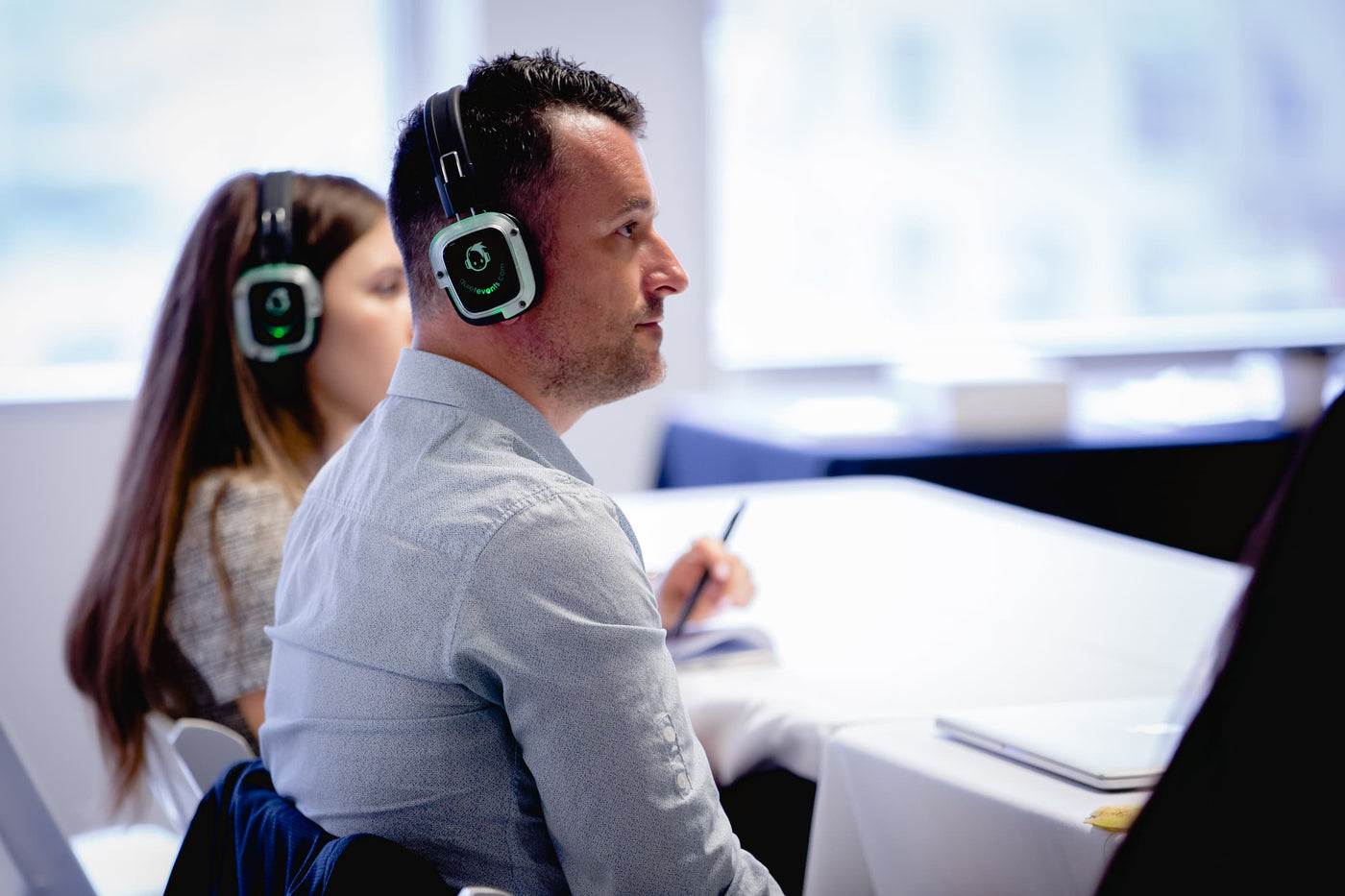
-

12 Hours
Battery Life (fully charged)
-

3,10 & 45 Channels
Of Audio w/ LED Lights
-

Individual Transmitters
Per Channel that can be Placed Anywhere
-

Works up to over 1,500 feet
From the base (over 4 football fields long)
-

All headphones come sanitized
And fully charged
-

Over the ear style
Cutting down on most outside noise
-

Simple setup
All you need to do is just Plug & Play
-

Professional sound quality
(Less than 1% distortion)
-

Anti-theft device
Installed to ensure headphones are returned


Shop the best Silent Disco headphones
View all-


Wireless Home Audio Silent Disco System
$399.00 USD$450.00Unit price /Unavailable -

Wireless Home Audio Silent Disco System (TV & Projectors) - 10 Pack
$1,349.00 USDUnit price /Unavailable -

 Clearance
Ultra2 600 (13CH) - Silent Disco Headphone (ADA Compliant)
$34.99 USDUnit price /Unavailable -


Ultra 900 Transmitter - USED (10CH) - Silent Disco
$99.00 USDUnit price /Unavailable -
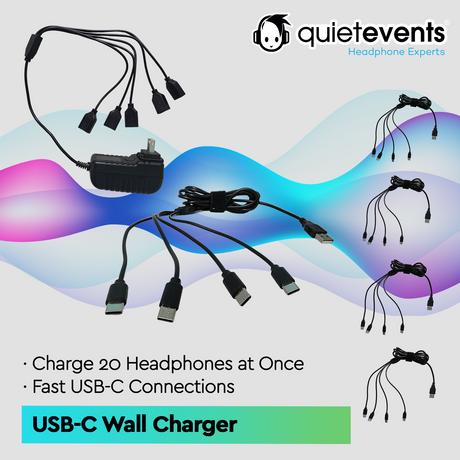

USB-C (Fast Charging) - 20 Headphone Charging AC Wall Set Power Adapter (Ultra1, Ultra2, 600, & 900)
$37.00 USDUnit price /Unavailable -


Ultra2 900 - USED (13CH) - Silent Disco Headphone - (ADA Compliant)
$34.99 USDUnit price /UnavailableBuy NewBuy Used


